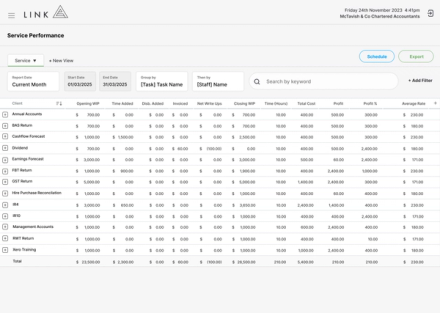
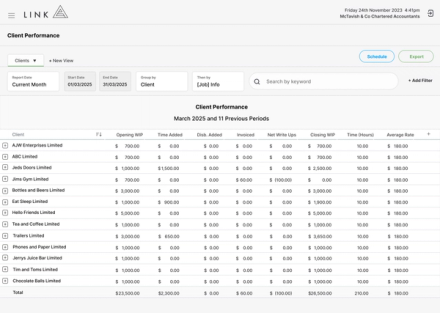
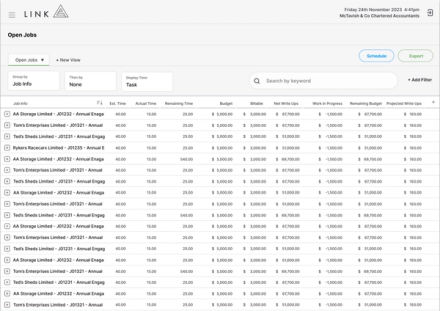
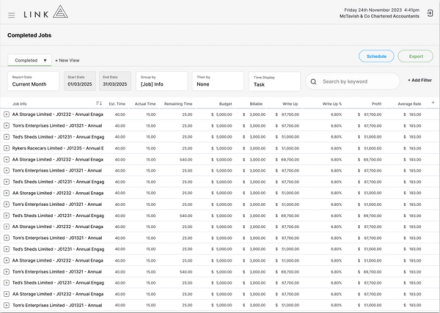
A living record of what we've shipped and what's coming next.
Most reporting tools produce numbers that change depending on which screen you're looking at. That's not reporting. That's guesswork with a dashboard.
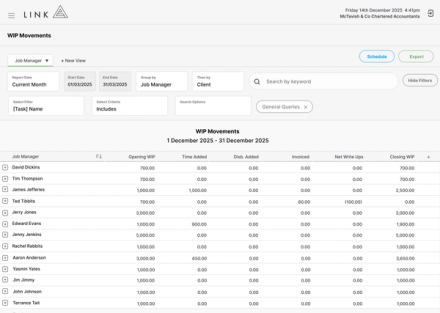
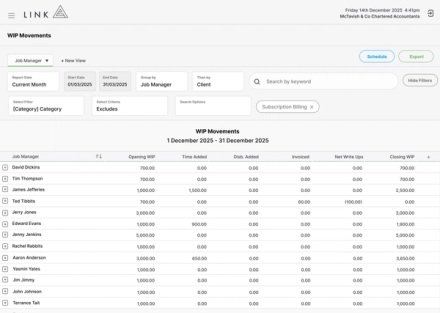
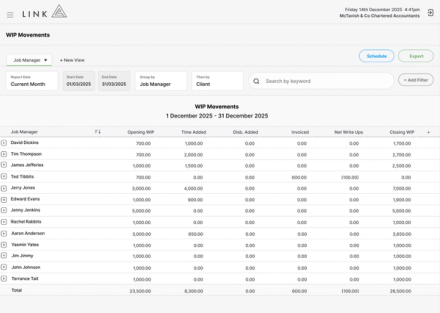
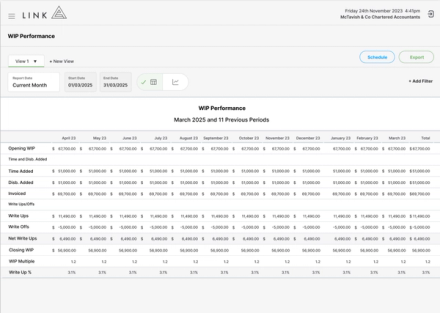
Most firms find out about WIP overruns after the invoice has gone out. By then the write-off is already inevitable.
Fixed fees look predictable on the surface. Underneath, the recoverability picture is often very different.
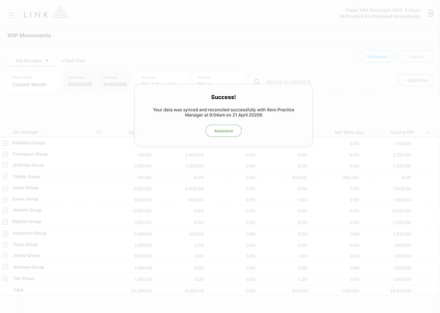
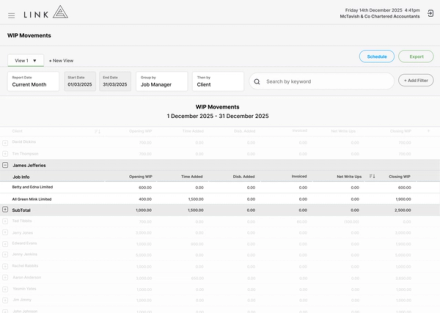
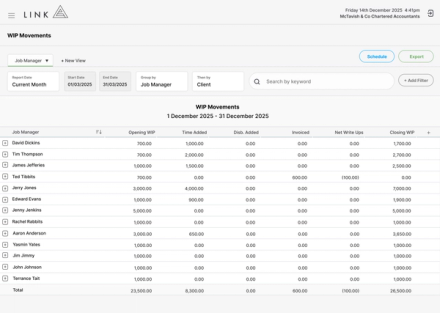
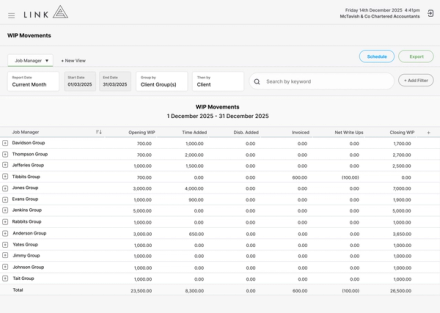
When you invoice by Client Group, small balances on minor jobs can hold up the invoice for other entities.
The average firm carries two months of WIP. Firms that use Link carry one month or less. The difference goes straight to invoicing.
General queries and quick client requests generate WIP. Most firms only see it at write-off time.
Most firms only notice a stagnant job once the WIP balance is already too big to ignore. By then it's a write-off conversation, not a workflow one.
Reviewing August write-offs in September is still helpful. Just not as helpful as having the same conversation while the job is still open.
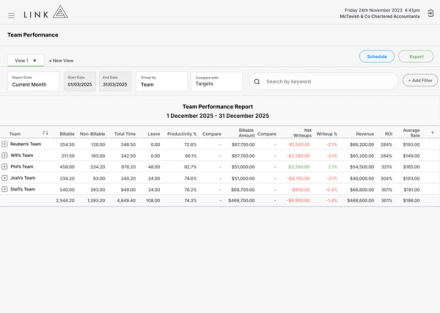
You find out someone missed target when the month closes. By then there is nothing left for them to act on.
Write-off percentages don't compare between people. They're driven by the billable rate you set, not the work someone did.
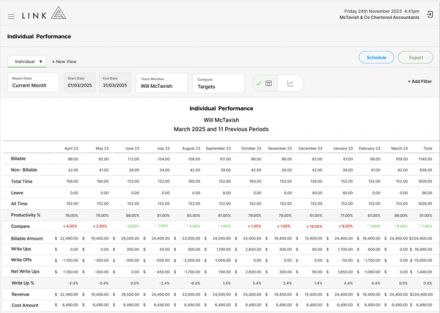
You know what the firm invoiced last month. Who generated it is a different question.
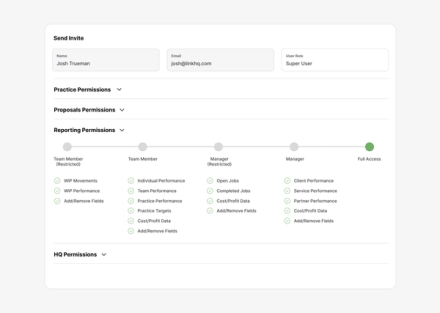
Reporting that lives behind a login gets opened once a quarter. The firms that improve look every week.
Most firms only discover that growth cost them margin when the year-end numbers come in lower than expected.
A team member running consistent net write-ups of 10% isn't outperforming. Their billable rate is set 10 to 20% below where it should be.
Most firms hire once the team is already underwater. By then you're recruiting under pressure instead of to a plan.
Write-off percentages can't answer that. They're driven by the billable rates you set, not by what the work actually recovered.
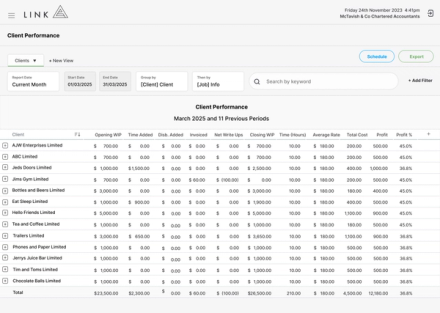
Most firms treat every client as equally valuable. Recovered rates, write-offs and profit tell a very different story.
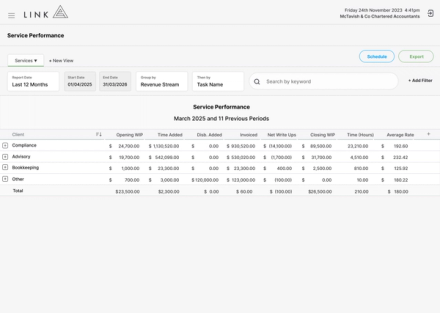
Advisory should recover a higher rate than compliance. Most firms assume it does without ever checking.
Re-pricing without data is a difficult conversation you keep putting off. Most underpriced engagements stay that way for years.
On most fixed fee jobs the overrun shows up as a write-off at the end. By then there's nothing to do but absorb it.
A write-off total tells you there's a problem. Most firms never get past the total to the cause.
Recovered rate tells you what you charged per hour. It says nothing about what the hour cost you to deliver.
When the queue isn't ordered by value, your biggest invoices sit behind your smallest jobs.
Work gravitates to your best people. Left alone, that overloads your strongest managers and leaves capacity idle elsewhere.
Revenue per client tells you what you invoiced. Most firms never look past it to the capacity required to service the client.
Most partners promise the client first and work out whether anyone has the capacity to deliver it later.
In most systems leave changes nothing. The work waits for you, so people either skip leave or come back to a worse week than the one they left.
Most workflow systems have no state for outsourced work. It leaves your team and disappears until it comes back.
When this month's work is done, most teams stop. Next month's work isn't in front of them, so nobody starts it.
When work is split across boards and filtered views, no manager can see their their client responsibilities at once.
Budgets that never made it onto the job can't warn you about anything. In most firms they're set once, by hand, on the jobs someone remembered.
Missing partners, managers, categories and budgets quietly break your reporting. Most firms don't notice until they're relying on the numbers.
Deadlines scattered across jobs, boards and spreadsheets aren't deadlines. They're surprises with a date attached.
In most systems a sick day changes nothing. You come back to the same deadlines with less time to hit them.
Most capacity plans assume every week is five days. Public holidays quietly turn a full week of work into four.
When work is spread across boards and personal lists, tasks get lost. Usually the ones nobody was watching.
When a task can only hold one name, the reviewer never sees it coming until it lands on their desk.
Most systems report at firm level or individual level. Nothing in between, which is exactly where multi-office firms are run.
Busy and finished are not the same thing. Most systems measure activity and let completion look after itself.
Leave usually surfaces the week it happens. By then the work has already been allocated to someone who won't be there.
Finding out you missed your productivity target after the month closes tells you something. It just doesn't give you anything to do about it.
Updating the same job in two systems isn't integration. It's double handling with extra steps.
Most integrations fail quietly. You find out weeks later when a number doesn't add up and nobody can say why.
Most apps split work across multiple boards and filtered views. Everyone ends up rebuilding their own list somewhere else.
Every other workflow app gives you six places to look, and not one of them can be put in priority order. At best you get a sort.
When a client rings to ask where their work is up to, most partners have to check with someone and call back.
When only managers can allocate work, every team member between tasks is waiting on someone else.
Hunting for the right job in another system is a small cost, repeated thousands of times a year.
Generic job or task statuses tell you nothing. Work that's stuck looks identical to work that's moving.
Most firms plan a few weeks ahead because estimating effort, assigning work and balancing capacity manually takes too long. Beyond that, it's guesswork.
A weekly scheduled report tells you someone missed their target. It doesn't tell you in time to help them hit it.
When the conversation about a job lives in email, the context is gone by the time anyone needs it.
What's worse: waking up to a tonne of emails from your offshore team, or none?
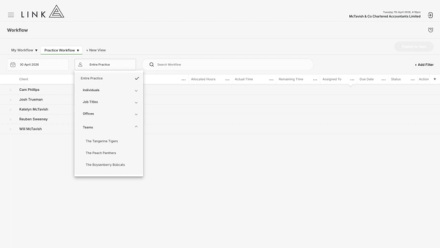
In a larger firm every manager can see and reorder the whole practice's workflow, including the people who don't report to them.
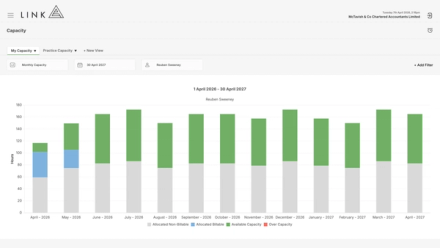
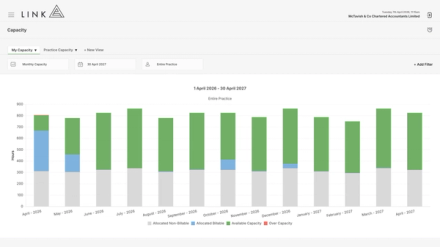
A red available capacity number tells you there is a problem. Now it tells you where your hours went.
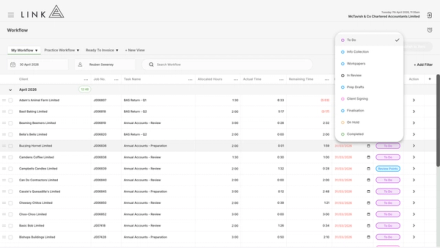
Out for signing, ready to invoice, finalisation. Tasks sit in your team's workflow long after their part in them is done.
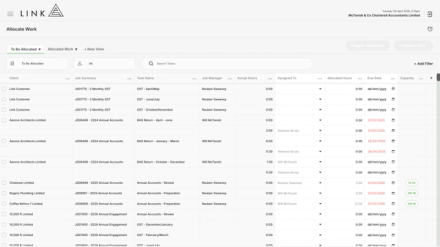
Last year's data suggests who, when and how long. Smarter workflow allocation lets you select the best option from each.
A job that went to client queries yesterday and one that has been there two weeks look exactly the same in Xero Practice Manager.
Most client work needs two or more people. Adding each one, task by task, is why review time never makes it into the plan, and why reviewers get stressed.
A reviewer finds out work is waiting when someone walks over and tells them, or when an internal email gets sent.
A task goes on hold and only a manager can update the due date, so the list your team works from is one step behind.
Most firms discover a job was underpriced when the write-off appears. The allocation was telling you months earlier.
New team members usually spend their first months guessing at the standard they're being measured against.
A number in a report nobody can interrogate isn't a target. It's a verdict.
Client managers get assessed on relationships, because the numbers behind their client list were never visible.
Recovered rate tells you what you charged per hour. It doesn't tell you what the work cost to deliver, so two clients on the same rate can return very different margins.
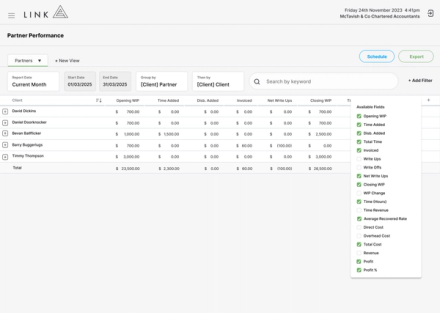
When partner contribution can't be measured, profit share becomes a negotiation instead of a calculation.
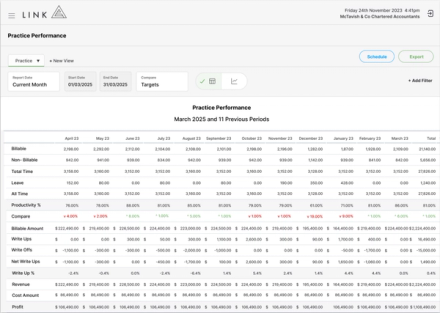
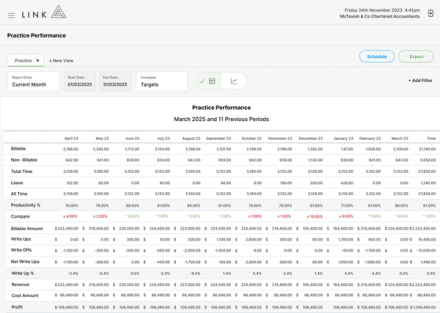
Most firms can tell you this year's numbers. Far fewer can tell you whether they're better than last year's.
When everyone can see every number, nobody is clear on which one they're accountable for.
Software cost per client keeps climbing. Most firms absorb it because nobody is tracking which client uses what.
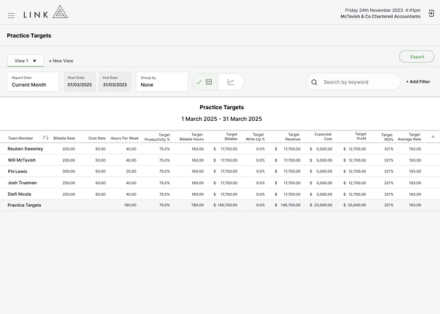
Most firms set a revenue number and hope. There's no line of sight between the number on the wall and the people, hours and rates that have to produce it.